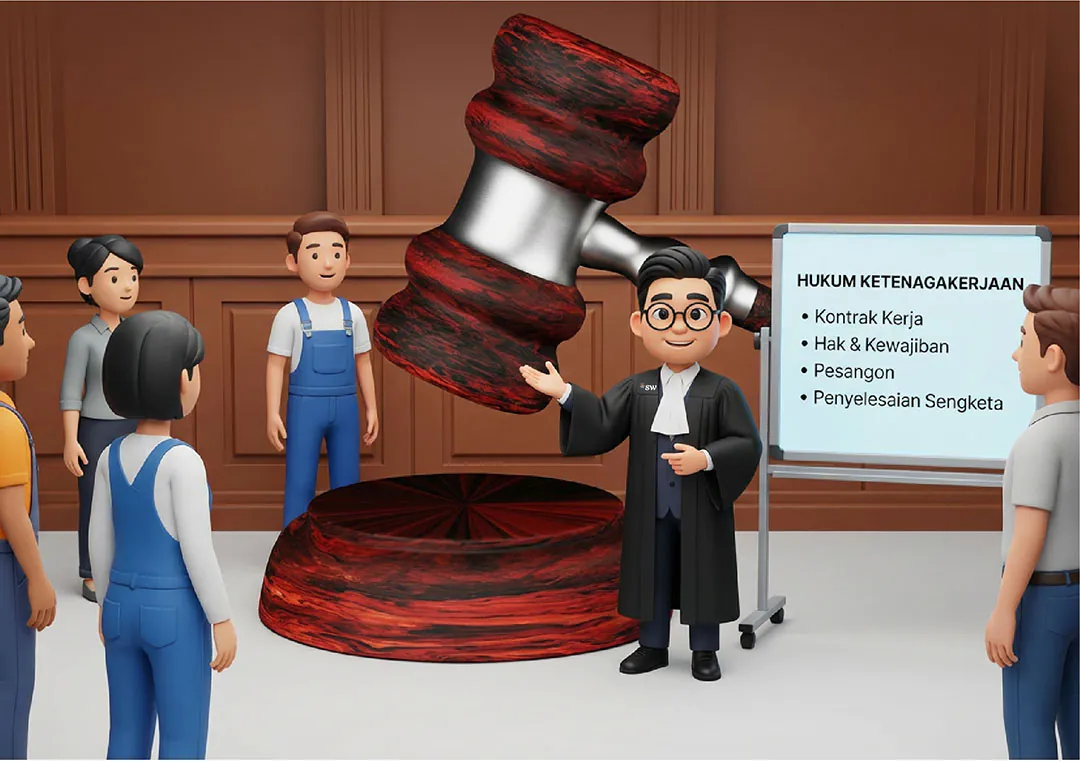
Indonesian Labour Law plays a strategic role in corporate governance amid rapid business growth and digital transformation. The regulatory framework is centered on the Job Creation Law and its implementing regulations, aiming to balance business flexibility and worker protection. This article examines key labour law aspects, including employment relationships, wages, working hours, termination, and occupational safety. Regulatory complexity and frequent legal changes present significant compliance challenges for companies. Misclassification of employment status and inadequate HR documentation often lead to industrial disputes. Labour law compliance supports operational stability and effective legal risk mitigation. The strategic role of HR functions in legal awareness has become increasingly critical. The article concludes that legal certainty and compliance are essential to achieving harmonious and sustainable industrial relations.
Amid business acceleration and digital transformation, labor issues occupy a strategic position within corporate management. No longer limited to Human Resources (HR) matters, labor compliance has become an integral part of risk mitigation, governance, and corporate reputation. Indonesia’s business environment continues to adjust its regulatory landscape to respond to the dynamics of the labor market in an era of globalization and mobility, especially following the enactment of the Omnibus Law on Job Creation.
Quoting Hans Kelsen, “Law is not about morality, but about certainty.” In the context of labor relations, certainty becomes the key word sought by both employers and workers: how rules are understood, implemented, and enforced consistently.
Indonesia’s labor law framework currently revolves around the Omnibus Law on Job Creation and its implementing regulations, including among others:
- Government Regulation (PP) 35/2021 on Employment Agreements, Working Hours, Employment Relations, and Termination of Employment;
- PP 36/2021 on Wages;
- Minister of Manpower Regulation (Permenaker) 5/2021 on Wage Structure and Scale;
- Permenaker 6/2021 on Religious Holiday Allowance (THR);
- Permenaker 1/2022 on Minimum Wage;
- Permenaker 2/2022 on Old Age Security (JHT).
These reforms bring a new spirit: providing flexibility for businesses while maintaining protection for workers. This aligns with Lon L. Fuller’s view that effective laws must “be acceptable to the real world” not only correct on paper but also practical and enforceable. However, this regulatory evolution also raises technical questions: Has the Fixed Term Employment Agreement (PKWT) complied with the limits on duration and job type? Has the company prepared its wage structure and scale in accordance with the regulations? Have the company regulations or the Collective Labor Agreement been approved by the relevant authority?
For many companies, the main challenge is not the intention to comply, but understanding the complex and frequently changing technical details. Incomplete HR documentation may become a dispute risk in the future.
One of the most common dispute triggers is the determination of employment status. Misclassification between PKWT, Indefinite Term Employment (PKWTT), or outsourcing arrangements may lead to significant financial consequences.
Other frequently encountered issues include:
- Working hours and overtime;
- Wage structure and scale;
- Implementation of Religious Holiday Allowance (THR);
- Changes in severance compensation formulas under PP 35/2021;
- Implementation of Occupational Safety and Health (K3), particularly within remote or hybrid work arrangements;
In the context of termination of employment (PHK), documentation becomes extremely crucial from performance evaluations and warnings to minutes of internal mediation. At this point, Gustav Radbruch’s view becomes relevant: “Order is more important than justice, if order is the condition for justice.” Without organized and orderly documentation, justice becomes difficult to achieve for both workers and employers.
In business practice, three major challenges are commonly encountered:
- Regulatory Complexity
Numerous derivative regulations exist, inter-agency interpretations may differ, and updates occur rapidly. - Dispute Risks and Litigation Burden
Once a case enters the Industrial Relations Court, it requires substantial time and financial investment, and may affect corporate reputation.
- HR Readiness
HR often serves as the company’s “legal frontliner,” yet not all HR personnel possess adequate legal competence. As work patterns shift remote, hybrid, digital—new questions emerge: Does a work accident at home qualify as a workplace accident? How should digital attendance be managed? This is where PP 44/2015 on Work Accident Insurance (JKK) and Minister of Manpower Regulation (Permenaker) 5/2018 on Occupational Safety and Health in the Work Environment become relevant.
Labor compliance creates a dual impact:
- For companies: operational stability, lower turnover, and strengthened reputation.
- For workers: security, clarity of rights, and higher motivation.
Plato once said, “Justice is harmony.” In the corporate world, harmony is created when rules are mutually upheld, communication is transparent, and documentation is consistently executed. To navigate Indonesia’s labor landscape safely, companies may adopt the following measures:
- Conduct annual labor audits to identify compliance gaps;
- Standardize HR documents, particularly for PKWT, company regulations, disciplinary SOPs, and performance management;
- Implement labor law training;
- Digitize HR processes;
- Hold regular dialogue with employees.
The approval process for Company Regulations (PP) or Collective Labor Agreement (PKB) under Minister of Manpower Regulation (Permenaker) 28/2014 includes:
- Drafting the company regulations/PKB;
- Submitting the draft to the Manpower Office;
- Evaluation by the Manpower Office;
- Issuance of approval letter.
Marcus Aurelius once wrote, “What is not good for the hive is not good for the bee.” In the context of labor relations, compliance does not solely protect the company or employees individually, but safeguards the entire ecosystem to remain orderly, fair, and competitive. Companies that internalize legal compliance as a culture not merely an administrative obligation will be the ones best prepared to face the future and mitigate legal risks more effectively.
Engaging the right legal consultants helps foreign investors safeguard against future legal issues. For instance, SW Counselors at Law assists clients in drafting Company Regulations or Collective Labor Agreements and securing approval from regulators.
Of course, involvement of legal experts does not guarantee freedom from legal claims; this applies to investments in any country. However, if the involvement of legal consultants alone is not a guarantee, the absence of such involvement poses even greater risks.siness growth, ultimately optimizing their return on investment in Indonesia.