

PSAK 118 is an accounting standard designed to enhance the quality, transparency, and comparability of financial statements through a more structured presentation and disclosure framework. The standard requires classification of income and expenses into operating, investing, financing, tax, and discontinued operations categories, along with consistent presentation of key performance subtotals. It also strengthens aggregation and disaggregation principles and clarifies disclosures related to Management-Defined Performance Measures (MPMs). In addition, the standard improves information quality through requirements on disclosure practices, cash flow classification, earnings per share, and the use of professional judgment in financial reporting. Its implementation requires adjustments in systems, processes, and corporate governance, as well as enhanced cross-functional coordination. Despite implementation challenges, the standard improves the relevance and reliability of financial information for users. Overall, PSAK 118 reinforces transparency as a foundation for economic decision-making and market confidence.
The presentation and disclosure of financial statements are fundamental aspects of financial reporting since it provides stakeholders with critical information regarding an entity’s financial performance, financial position, and cash flows. Recognizing the importance of transparent and informative financial reporting, the Indonesian Financial Accounting Standards Board introduced PSAK 118, which establishes the principles and requirements governing the presentation and disclosure of financial statements.
Objectives and Benefits
The primary objective of PSAK 118 is to enhance the quality and usefulness of financial statements by establishing standardized principles for presentation and disclosure. The standard provides detailed guidance on the consistent presentation of line items, classification and disclosure, and the principles of aggregation and disaggregation, ensuring that financial information accurately reflects an entity’s economic activities and financial position in a clear, structured, and consistent manner. By conforming to these principles, PSAK 118 promotes greater transparency, comparability, and understandability in financial reporting, encouraging a reliable basis for evaluating financial performance.
The adoption of PSAK 118 provides significant benefits to both preparers and users of financial statements. It enhances more effective decision-making by presenting financial information in a structured and meaningful format, enabling users to assess an entity’s performance, position, and cash flows with clarity. Standardized presentation and disclosure enhance comparability across reporting periods and entities, reduce the risk of misinterpretation, and strengthen the reliability of financial analysis. Compliance with PSAK 118 also ensures regulatory conformity, aligns reporting with international standards, and increases stakeholders’ confidence in the accuracy, credibility, and reliability of financial statements.
Highlights of PSAK 118 Changes
The most fundamental change under PSAK 118 is the introduction of a more structured statement of profit or loss and other comprehensive income. Income and expenses are now required to be classified into defined categories such as operating, investing, financing, tax, and discontinued operations. This removes much of the flexibility that existed under PSAK 201 and ensures that entities present financial performance in a more consistent format.
Another major change is the requirement to present defined subtotals, especially “operating profit” and “profit before financing and income taxes”, which must now be calculated and reported consistently across all entities. This reduces diversity in how “core performance” is defined and makes financial results more comparable across entities.
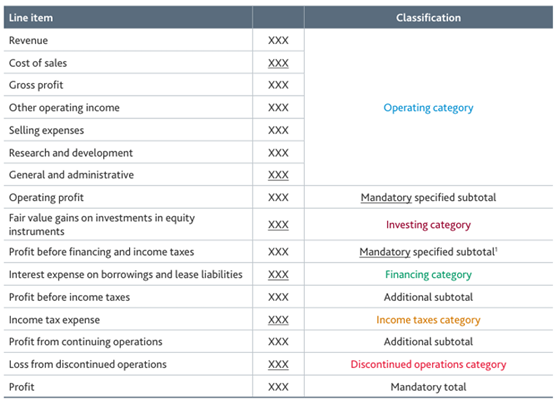
Entities with a Specified Main Business Activity (SMBA) are subject to specific classification requirements. For these entities, certain income and expense items are classified and presented within the operating category rather than the investing or financing categories. The SMBA assessment is performed at the reporting-entity level. Therefore, a Group’s SMBA may differ from that of its individual entities.
 | |
New Disclosures Requirements
PSAK 118 strengthens transparency by clearly distinguishing between performance measures defined by the standard and those used internally by management. When entities report Management-Defined Performance Measures (MPMs), such as adjusted profit figure, they must explain what these measures represent, how MPMs are calculated, and the rationale for their use. In addition, entities are required to provide a reconciliation between each MPM and the closest PSAK-defined subtotal, allowing users to see the relationship between internally defined measures and standardized financial results. By establishing these disclosure requirements, PSAK 118 ensures that both standardized and management-adjusted performance information is presented in a manner that is transparent, comparable across periods, and meaningful for decision-making.
Entities may present operating expenses by nature, function, or a combination of both, depending on which approach provides the most useful information to users of the financial statements. PSAK 118 provides guidance to assist entities in determining the most appropriate presentation based on their specific facts and circumstances. Where expenses are presented by function, entities are required to disclose additional information on the nature of the expenses included within each operating-category line item in the statement of profit or loss.
Other Significant Requirements
PSAK 118 provides enhanced guidance on the principles of aggregation and disaggregation, with a clear focus on grouping items based on shared characteristics. These principles are applied across all components of the financial statements and play a key role in determining both the line items presented in the primary financial statements and the level of detail disclosed in the notes. In applying this guidance, management is expected to exercise judgment to ensure that information is neither overly aggregated nor unnecessarily detailed. The objective is to achieve a balanced presentation that faithfully represents the nature of transaction and supports understanding of the entity’s financial performance.
The previous policy choice for classifying interest and dividends in the statement of cash flows has been removed. Under the revised requirements, dividends and interest received are classified as investing cash flows, while dividends and interest paid are classified as financing cash flows. This change eliminates diversity in practice and strengthens comparability across entities and reporting periods.
PSAK 118 also clarifies the presentation of earnings per share (EPS). EPS must be determined and disclosed based on the profit subtotal defined in accordance with the standard. Any additional EPS measures that are not based on the standard-defined subtotal of profit may not be presented in the statement of profit or loss. Instead, such alternative measures may only be disclosed in the notes to the financial statements, where they can be appropriately explained without impairing comparability.
The standard further provides guidance on the classification of foreign exchange differences, as well as gains and losses arising from derivatives and hybrid contracts. As a general principle, foreign exchange differences should be classified in the same category as the income or expense item that gave rise to the difference. However, where such alignment would involve undue cost or effort, PSAK 118 permits classification of these foreign exchange differences within the operating category.
PSAK 118 emphasizes the requirement that all line items in the financial statements must be clearly described to reflect their economic substance. The use of generic or non-descriptive labels such as “Other” is discouraged, as it may reduce transparency and limit users’ ability to understand the composition of financial statement items. Where the use of such labels is unavoidable, management is required to provide additional disclosures that clearly explain the nature and composition of these items.
Implementation Challenges of PSAK 118
Implementing PSAK 118 presents several practical and technical challenges that management must address to ensure a smooth transition and high-quality financial reporting. A key challenge lies in existing accounting systems, particularly for entities with complex operations. Many systems may not be fully equipped to accommodate the expanded presentation requirements, additional subtotals, and enhanced disclosure demands. System enhancements or upgrades may therefore be necessary to ensure that financial information can be captured, classified, and reported accurately and efficiently.
Another important challenge relates to the level of detail required in disclosures.
PSAK 118 demands more detailed information to support enhanced disaggregation and transparency. For organizations with multiple subsidiaries, business units, or decentralized operations, ensuring consistent definitions, timely consolidation, and data integrity can be complex and resource-intensive.
The implementation of PSAK 118 also increases reliance on management judgment, particularly in assessing materiality, making classification decisions, and determining appropriate levels of detail for disclosure. Inconsistent application of these judgments across the organization can reduce comparability and create potential inconsistencies in financial reporting. Moreover, the changes introduced by the standard affect multiple aspects of financial reporting, requiring strong internal alignment and coordination across finance, operations, and reporting functions. Effective governance and clear communication are therefore essential to ensure that all stakeholders interpret and apply the requirements consistently, maintaining the reliability, transparency, and usefulness of the financial statements.
Approach to Implementing PSAK 118
Successful implementation of PSAK 118 requires a structured and phased approach to ensure that the new requirements are fully understood and effectively integrated into financial reporting processes. The process typically begins with a comprehensive gap analysis, where current accounting policies, reporting structures, and disclosure practices are compared against PSAK 118 requirements. This step allows management to clearly identify areas that need to be updated, whether in policies, systems, or reporting processes. Once the gaps are identified, organizations should focus on updating accounting policies to align with the new presentation and disclosure requirements. Ensuring consistency across all reporting units is essential, and clear documentation of revised policies supports reliable application across the organization.
The next phase involves system and process readiness. Accounting systems may require adjustments to accommodate new line items, subtotals, and enhanced disclosure requirements. At the same time, comprehensive processes should be designed for collecting and consolidating detailed information to ensure timely, accurate, and consistent reporting.
People readiness is equally important. Finance teams should receive focused training on the new requirements, and clear communication should be maintained with relevant stakeholders to ensure alignment and minimize misinterpretation. Entities should also consider performing a pilot financial reporting exercise or parallel run to test the new processes, identify any gaps or inconsistencies, and make adjustments before full-scale implementation.
Overall, compliance with PSAK 118 should be treated as an ongoing process. Management should regularly review and improve reporting processes and disclosures to maintain clarity, relevance, and compliance. By adopting a continuous and proactive approach, financial statements will consistently provide transparent, reliable, and decision-useful information, encouraging stakeholder confidence and supporting well-grounded decision-making.