
The implementation of PSAK 118 (IFRS 18 adoption) introduces a significant transformation in financial reporting architecture that goes beyond technical requirements, fundamentally influencing how corporate performance is communicated to stakeholders. For complex organizations such as state-owned enterprises and large business groups, the standard creates challenges in classifying operating, investing, and financing activities, as well as in ensuring consistency in performance narratives across entities. During this transition, the need for objective professional judgment becomes increasingly important, particularly in areas requiring complex accounting assessments. Independent advisors play a critical role in supporting readiness evaluation, providing cross-industry benchmarking, and strengthening the technical basis for reporting decisions. Accordingly, PSAK 118 should be viewed not merely as an accounting standard change, but as a catalyst for enhancing the overall quality of reporting governance and performance communication.
When the corporate world discusses the transformation of financial reporting, many entities still perceive PSAK 118 (the adoption of IFRS 18) merely as a structural reformatting of the statement of profit or loss. However, for organizations with
complex business architectures, particularly State-Owned Enterprises (SOEs), this standard fundamentally reshapes how investors, creditors, regulators, and the public evaluate corporate performance. Effective for annual periods beginning January 1, 2027, PSAK 118 introduces a paradigm shift in financial statement presentation, requiring significantly higher levels of transparency, consistency, and comparability. Amidst the rising demand for national investment, the quality of financial reporting has become an increasingly critical factor under scrutiny by capital providers.
Aristotle once said, “Well begun is half done.” Organizations that commence their preparations early will possess a distinct advantage, enabling a more structured transition than peers that defer action until the effective date approaches.
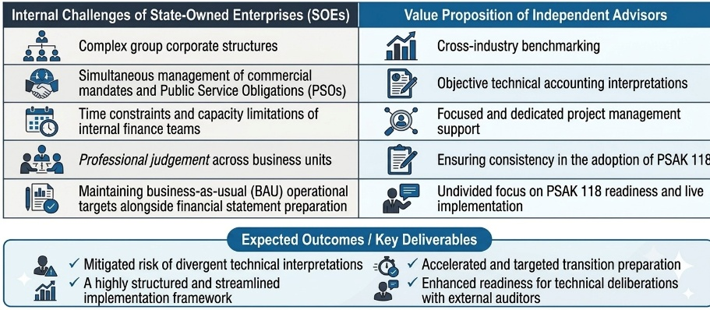
For large conglomerates and SOEs, the implementation of PSAK 118 transcends a mere accounting exercise. The structural challenges encompass ensuring consistency in the classification of operating, investing, and financing activities, harmonizing accounting policies across diverse subsidiaries, and crafting a clear, cohesive performance narrative that can be seamlessly interpreted by the investment community.
Given these complexities, the role of independent advisors becomes increasingly critical. Advisors assist companies by providing an objective perspective, cross-industry benchmarking, and a more structured execution methodology. Furthermore, engaging professional advisors equips management with robust technical rationale when navigating areas requiring significant professional judgment, thereby strengthening their position during technical deliberations with external auditors and regulators.
Within many finance functions, reporting teams have operated under a relatively static presentation framework for years. This continuity naturally fosters deep-seated mindsets and ingrained interpretations of transaction structures and financial statement presentation. Consequently, when a disruptive standard is introduced, organizations often struggle to evaluate legacy processes through an objective lens. This is precisely where the intervention of an independent advisor becomes imperative.
Independent advisors provide an evaluation unencumbered by internal biases, departmental interests, or historical preferences that have developed over time. Drawing on institutional experience across various sectors, advisors introduce critical benchmarks that are difficult to establish solely through internal management discussions.
Beyond providing objectivity, leveraging external advisory expertise mitigates the risk of divergent interpretations in areas requiring complex professional judgment. In financial reporting practice, technical accounting issues rarely present binary, black-and-white answers. An independent advisor enables management to formulate well-supported, thoroughly documented technical positions prior to engaging in formal discussions with auditors and regulatory bodies.
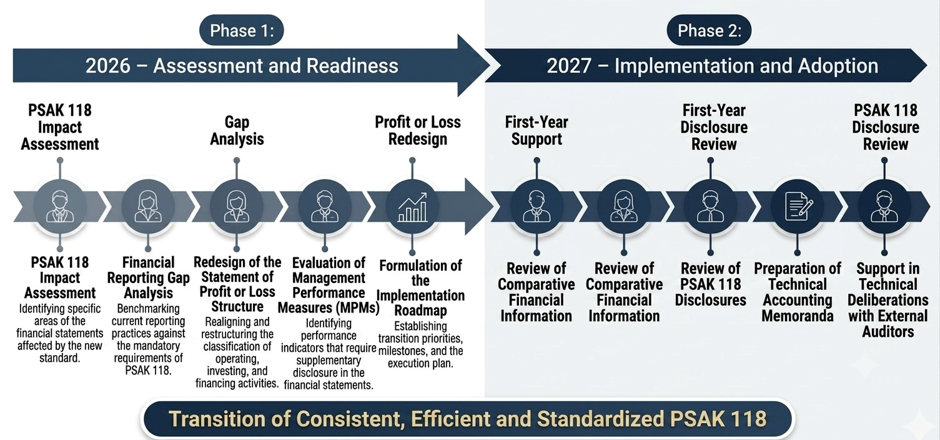
In the context of PSAK 118, 2026 must be treated as a strategic preparation period. During this phase, the primary objective is not to implement changes within the financial statements themselves, but rather to evaluate the systemic implications of the standard on existing reporting workflows. Organizations must identify impacted areas, conduct data readiness assessments, understand structural changes within the statement of profit or loss, and re-evaluate the key performance indicators (KPIs) historically used in management reporting and shareholder communications.
Conversely, 2027 represents the actual implementation phase, marking the formal adoption of the standard. At this stage, the focus shifts from identifying issues to resolving practical execution challenges that emerge during live application. Precedents from prior major accounting standard transitions indicate that nuanced implementation issues often surface only when entities begin preparing live financial statements under the new framework. Consequently, the demand for professional technical guidance typically intensifies during the initial year of adoption.
Fundamentally, 2026 should be designated for impact assessment and readiness, while 2027 is reserved for live implementation. The most effective approach is to seamlessly connect these two phases, ensuring the organization is fully prepared not only from a technical accounting perspective but also operationally.
How Advisors Deliver Value
The role of an advisor in the implementation of PSAK 118 is not to supersede management or displace the internal financial reporting team. Rather, the advisor acts as a catalyst to accelerate organizational adaptation to the new financial reporting requirements. During the readiness phase, advisory services focus primarily on impact mapping and diagnostic assessments. The objective is to provide management with a clear understanding of impending structural changes, high-risk areas, and priority actions required ahead of the effective date. In this phase, advisors also assist in designing an implementation roadmap tailored to the company’s unique business model and corporate structure.
Upon entering the implementation phase, the advisory focus shifts toward practical application. Advisors work alongside the company to verify that the classification, presentation, and disclosure of items strictly comply with the core principles of PSAK 118. Additionally, they serve as a technical sounding board when addressing complex accounting issues that arise during the financial statement closing process and subsequent external audit cycles.
Ultimately, the core value proposition of an independent advisor extends beyond mere regulatory compliance; it lies in the capacity to help organizations translate the principles of PSAK 118 into sustainable, consistent, and institutionalized financial reporting practices.
As part of our Business Advisory practice, SW Indonesia maintains a dedicated team of professionals with extensive experience in guiding enterprises through complex financial reporting transformations, the implementation of new accounting standards, and the strengthening of corporate governance and regulatory readiness.
Our methodology extends beyond basic compliance, ensuring that operational transitions are executed in a practical, sustainable manner and in alignment with the specific commercial realities of each client.
Peter Drucker once noted, “What gets measured gets managed.”. Under the PSAK 118 framework, the presentation quality of financial information will increasingly shape how corporate performance is perceived and valued by the market. Therefore, the implementation of PSAK 118 should not be viewed narrowly as a compliance requirement, but rather as a strategic initiative to enhance transparency, strengthen investor confidence, and improve long-term corporate competitiveness.