

Generative Artificial Intelligence (GenAI) plays a significant role as a solution for business optimization in the era of digital transformation. In business, GenAI enhances operational efficiency and supports data-driven decision-making. This technology works synergistically with analytics to transform data into easily understandable insights. Its implementation covers various financial processes such as Record to Report (R2R), Order to Cash (O2C), Procure to Pay (P2P), Acquire to Retire (A2R), and Financial Planning and Analysis (FP&A). The “Chat with Your Data” trend enables more natural interaction with data. The success of AI implementation depends on a well-integrated data infrastructure.
The digital transformation that is currently occurring in the business world is the result of a long journey of technological innovation. For more than eight decades, research in the field of Artificial Intelligence (AI) has continued to develop, starting from simple computational approaches to advanced technologies capable of imitating human thinking patterns.
In the early stage, AI systems based on rule-based systems were used to perform certain tasks based on predefined rules. Furthermore, Machine Learning (ML) technology emerged, which allows systems to learn from historical data to recognize certain patterns. Then Deep Learning developed, which uses artificial neural networks to process data on a large and complex scale.
Now, the development of this technology has entered a new phase known as Generative Artificial Intelligence (Generative AI or GenAI). Unlike previous AI that only focuses on data analysis, Generative AI is able to create new content such as text, images, audio, and even business recommendations based on learned data patterns.
In the context of modern business, Generative AI is not merely a new technology, but has become a strategic tool to improve operational efficiency, accelerate decision-making, and open new opportunities for innovation across various industry sectors.
Seeing these developments, organizations require an approach that not only understands the technology, but is also able to integrate it effectively with existing business processes.
Evolution of AI in the Business World
AI has undergone significant evolution in the past few decades. Initially, AI systems were used to automate processes that are routine and rule-based. These systems are quite effective in stable environments, but have limitations when dealing with complex and dynamic data. The emergence of Machine Learning became an important point in the development of AI. With this approach, systems can learn patterns from historical data and use them to make predictions or decisions automatically. This technology has been widely used in various business applications such as fraud detection, credit scoring, and customer recommendation systems.
Furthermore, the development of Deep Learning opens new opportunities in processing more complex data, including image analysis, speech recognition, and natural language processing (Natural Language Processing) [FS1] . Generative AI is the latest stage of that evolution. This technology not only understands data, but is also able to generate new content that is relevant and contextual. This capability makes Generative AI a highly potential technology to support innovation in various sectors, ranging from finance, manufacturing, to digital services. Figure 1 provides a brief explanation of the development of the AI technology.
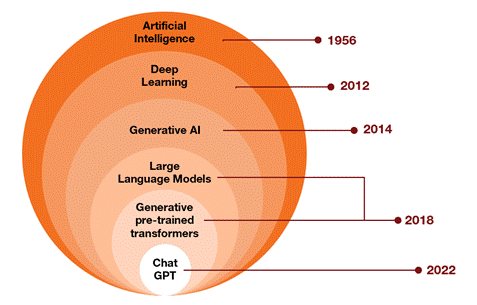
Figure 1. Development of AI
Synergy of Generative AI and Data Analytics
In its implementation, Generative AI works synergistically with AI Analytics and Machine Learning technologies. Traditional analytical systems usually produce outputs in the form of numbers, graphs, or dashboards that describe business conditions. However, the interpretation of these analysis results often still requires the involvement of analysts or business managers to understand the implications of the presented data.
Generative AI is present to bridge this gap by transforming analytical results into narratives that are easier to understand by decision-makers. This technology can automatically summarize key findings, explain the causes of data changes, and provide recommendations for actions that can be taken by management.
For example, an analytical dashboard may show that the sales of a product have decreased in a certain period. With the help of Generative AI, the system can provide additional explanations regarding the factors that may influence the decline, such as changes in customer behaviour, market conditions, or pricing strategies implemented by competitors. Thus, companies not only obtain data, but also gain deeper and actionable insights.
Application of AI in Financial Processes and Business Operations
In an increasingly complex modern business environment, the finance function no longer only acts as an administrative unit for recording transactions. Currently, the finance function has developed into a center of strategic analysis that supports management decision-making. Therefore, the utilization of technologies such as AI is becoming increasingly important to improve the efficiency and quality of financial processes.
In general, the transformation of financial processes in organizations can be grouped into five main areas, namely Record to Report, Order to Cash, Procure to Pay, Acquire to Retire, and Financial Planning and Analysis (FP&A). The implementation of AI in each of these areas can help organizations improve productivity, accelerate business processes, and reduce the potential for operational errors.
- Record to Report (R2R)
The Record to Report process includes all activities of recording and financial reporting within an organization. These activities include the preparation of financial statements, account reconciliation, regulatory reporting, and financial master data management.
By utilizing AI, various activities in this process can be automated, such as automatic account reconciliation, detection of transaction recording errors, and preparation of financial reports that are faster and more accurate. AI technology can also help ensure that the reports produced are in accordance with applicable accounting standards and regulations.
- Order to Cash (O2C)
The Order to Cash process includes the entire customer transaction cycle, starting from order receipt to payment receipt. In this process, AI can help companies manage customer orders more efficiently, process billing automatically, and identify potential payment delays.
In addition, AI can also be used to analyse customer payment patterns so that companies can manage credit risk better. Thus, the Order to Cash process can run faster and help improve the company’s cash flow.
- Procure to Pay (P2P)
On the procurement side, the Procure to Pay process includes activities starting from purchase requests, supplier management, invoice processing, to payments to suppliers.
AI can help automate various activities in this process, such as automatic invoice verification, detection of duplicate transactions, and analysis of company expenditures. Companies can improve transparency and efficiency in the procurement process while reducing the potential for errors in transaction management.
- Acquire to Retire (A2R)
The Acquire to Retire process is related to the management of company assets throughout their lifecycle, starting from asset acquisition, asset labeling, monitoring of asset usage, to asset disposal at the end of its useful life.
AI can help organizations track assets more accurately and provide analysis regarding optimal asset utilization. This technology can also be used to support asset investment planning and asset lifecycle management more effectively.
- Financial Planning and Analysis (FP&A)
The Financial Planning and Analysis area is a strategic function that supports planning and business decision-making. Activities in this area include the preparation of long-term plans, capital expenditure planning, product profitability analysis, and support for merger and acquisition activities.
With the help of AI, financial analysis processes can be carried out more quickly and comprehensively. AI is able to process large amounts of data to produce financial projections, business scenario analysis, and strategic recommendations for management.
New Trend: Chat with Your Data
One of the latest trends in the application of AI is the concept of “Chat with Your Data”. This approach allows users to interact with company data using natural conversational language. With this technology, users no longer need to write database queries or create reports manually. Instead, they can directly ask the system using everyday language.
For example, a financial analyst can ask: “What is the main cause of the change in the balance of the Prepaid Expenses account this month?” The AI system will then:
- Retrieve data from the data warehouse
- Analyse transaction changes
- Identify significant activities
- Present explanations in the form of a narrative
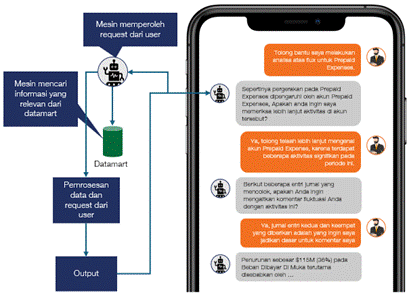
Figure 2 illustrates the flow of interaction between users and the AI system in the Chat with Your Data concept. This approach not only improves the efficiency of data analysis, but also helps organizations expand access to data across various business functions.
Anomaly Detection with Machine Learning
The ability to detect anomalies in data is becoming increasingly important in the modern business world. Machine Learning enables systems to learn historical transaction patterns and recognize deviations from those patterns.
For example, a customer who usually makes large transactions at the end of the month suddenly makes a large transaction at the beginning of the month. This pattern change can be considered an indication of an anomaly by the Machine Learning system.
Generative AI can then explain these findings intuitively to users through narratives that are easy to understand. This approach helps companies detect potential risks or unusual activities more quickly.
Data Infrastructure as the Foundation of AI
The success of AI implementation is highly dependent on the quality and management of data. Therefore, organizations need to build an integrated data architecture.
Modern AI architecture generally consists of three main layers:
- Data Source Layer
This layer includes various data sources such as ERP systems, operational transaction systems, as well as external data.
- Enterprise Data Layer
This layer functions to store and integrate data in a data warehouse or data lake.
- Data Consumption Layer
This layer allows users to utilize data through analytical dashboards, AI applications, as well as visualization platforms.
Figure 3 provides an overview of AI architecture. With the right data architecture, companies can utilize data as a strategic asset for business decision-making.
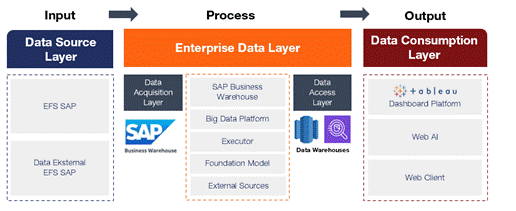
Figure 3. AI Architecture
Benefits of Generative AI in Financial Transformation
Generative AI provides various benefits in corporate financial management. In risk management, AI can simulate various economic scenarios to identify potential risks that may occur. In financial reporting, this technology can automate the preparation of financial reports in accordance with international standards such as IFRS. Meanwhile, in financial consulting, AI can provide personalized investment recommendations based on customer risk profiles. In Indonesia, integration with systems such as the Financial Information Service System (Sistem Layanan Informasi Keuangan/SLIK) OJK allows companies to conduct credit risk analysis more quickly and accurately.
Stages of Generative AI Implementation
The implementation of Generative AI in organizations requires a structured approach. The implementation stages usually include:
- Data pre-processing to ensure data quality.
- Fine-tuning AI models using relevant datasets.
- Use of synthetic data to improve model accuracy.
- Deployment through cloud infrastructure.
- Evaluation of model performance using analytical metrics.