
The implementation of PSAK 413 aims to ensure more accurate and transparent asset valuation in the financial statements of Islamic entities. PSAK 413 complements previous standards such as PSAK 109, PSAK 402, as well as ISAK 401 and ISAK 402. The development of this standard is part of efforts to strengthen the accounting framework for Islamic financial instruments in Indonesia. Its implementation is expected to improve the quality of financial reporting and governance. In addition, this standard helps entities adapt to evolving regulatory dynamics. Overall, PSAK 413 serves as an important foundation for enhancing the credibility and transparency of Islamic finance.
The Indonesian Institute of Accountants (IAI), through the Sharia Accounting Standards Board (DSAS), has approved Statement of Financial Accounting Standards (PSAK) 413 on Impairment. This PSAK specifically establishes accounting principles for impairment of financial assets arising from sharia-based transactions. The objective is to ensure accurate and transparent valuation of sharia-based financial assets, thereby improving the quality of financial reporting for entities engaging in such transactions.
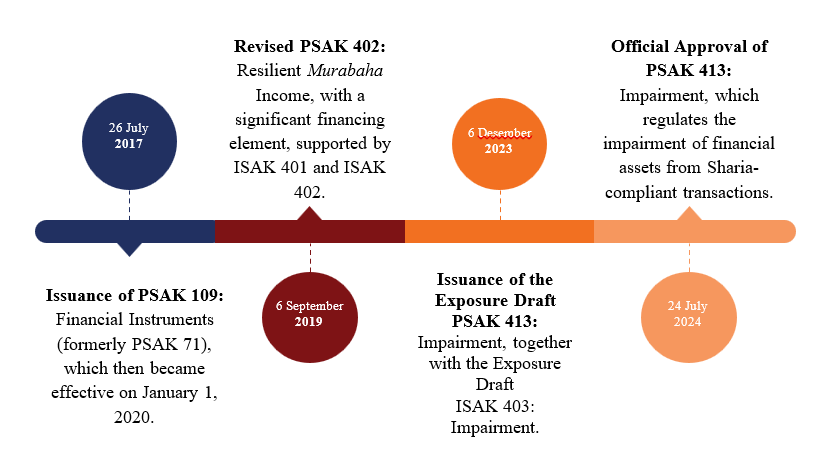
The development of PSAK 413 is part of a comprehensive effort to strengthen the accounting framework for sharia financial instruments in Indonesia. This standard is present to complement existing standards and interpretations, such as PSAK 109 (Financial Instruments), revision of PSAK 402 (Deferred Murabahah Income), and interpretations of ISAK 401 and ISAK 402 relating to murabahah accounting and impairment of murabahah receivables. With the dynamic nature of these changing accounting standards, it is hoped that entities can ensure appropriate implementation, increase financial reporting transparency, and support better governance in sharia-based transactions.
The journey towards ratification of PSAK 413 involved a series of important stages in the development of sharia accounting standards:
Context and Rationale
Accurately assessing the impairment of sharia financial assets is fundamental to maintaining the integrity and blessings of muamalah transactions. Inaccurate reporting can erode the trust of sharia fund owners (shahibul maal) and has the potential to disrupt amanah and maslahah (public benefit) of the sharia entity.
In this context, PSAK 413 is a vital instrument in maintaining sharia integrity and compliance. This standard requires entities to systematically evaluate the quality of sharia assets, identify impairment risks that could potentially deviate from the principle of prudence, and implement appropriate measures. The objective is to ensure that these risks are reflected transparently and honestly (siddiq) in the financial statements, providing a strong foundation for the entity’s accountability (hisab) to sharia fund owners and the Sharia Supervisory Board.
Moreover, PSAK 413 ensures that the management of impairment risk is in line with the principles of tadbir (good management) and prudence recommended in Islam, thereby strengthening the financial position and maintaining the sustainability (istiqamah) and welfare (maslahah) of sharia entities continuously.
Scope of Application
PSAK 413 is mandatory for all entities holding financial assets arising from sharia-based transactions and meeting the financial asset recognition criteria in accordance with the relevant PSAK. This includes, but is not limited to, Sharia Banks, Sharia Business Units (UUS), Non-Bank Sharia Financial Institutions, and other entities holding relevant Sharia financial instruments (e.g., murabahah, musyarakah, and mudharabah receivables) that require impairment assessment.
Important Implementation Details
- Come Into Force
Mandatory as of January 1, 2027 (for fiscal years beginning on or after that date). Earlier application is permitted. - Transitional Provisions
The adjustment for the impact of accounting changes related to previous impairments will be posted directly to the beginning balance of earnings. - Standard Replacement
PSAK 413 replaces ISAK 402 concerning Impairment of Murabahah Receivables.
Assets Within The Scope of PSAK 413
The following are sharia financial assets, which consist of the right to receive cash in an amount and at a time specified in the contract, which are covered by this standard. Takaful accounting is excluded from this standard.
- Murabahan Receivables
As regulated in PSAK 402: Murabahah Accounting. - Istishna Receivables
As regulated in PSAK 404: Istishna Accounting. - Receivables on Mudharabah Investments
As regulated in PSAK 405: Mudharabah Accounting. - Receivables from Business Results on Mudharabah Investments
As regulated in PSAK 405: Mudharabah Accounting. - Ijarah Income Receivables
As regulated in PSAK 407: Ijarah Accounting. - Qardh Financing
As regulated in PSAK 459: Sharia Banking Accounting. - Receivables on Musyarakah Investments
As regulated in PSAK 406: Musyarakah Accounting. - Receivables from Business Results on Musyarakah Investments
As regulated in PSAK 406: Musyarakah Accounting. - Sukuk Ijarah
As regulated in PSAK 410: Sukuk Accounting. - Wadiah Fund
As regulated in PSAK 459: Sharia Banking Accounting. - Reinsurance Receivables
As regulated in PSAK 408: Accounting for Sharia Insurance Transactions.
Main Stages of the Decline of Islamic Financial Assets
Tahap 1
- An impairment of sharia financial assets in the form of the right to receive cash, the amount and time of payment of which has been determined in the contract.
- Establishment of provision (Reserve for Impairment Losses (CKPN)) in the kafalah contract.
Tahap 2
Impairment of non-dā’in sharia financial assets (sharia non-debt type financial assets) such as mudharabah investments, musyarakah investments, and mudharabah sukuk.
Tahap 3
Impairment of value of non-financial sharia assets, such as ijarah assets.
Differences between PSAK 413 and PSAK 109 and PSAK 239
Although conceptually PSAK 413 has several similarities with the standards applicable to general accounting (PSAK 109 and PSAK 239), there are several specific differences that must be considered in the application of PSAK 413. This is mainly related to the classification, measurement and time value of money sections which will affect the calculation value.
| Criteria | PSAK 413 Impairment | PSAK 109 (previously PSAK 71) Financial Instrument | PSAK 239 (previously PSAK 55) Financial Instrument | ||
| Scope | Impairment of Sharia-Based Financial Instruments | Not only limited to sharia-based financial instruments | |||
| Classification | Stage1: Not bad Stage2: Bad | Stage1: Did not experience an increase in credit risk Stage2: Experiencing a significant increase in credit risk (“SICR”) Stage3:Experiencing worsening credit risk (Default) | Stage1: No impairment Stage2: Impairment | ||
| Measurement | Stage1: 12-month CKPN Stage2: Lifetime CKPN | Stage1: 12-month CKPN Stage2: Lifetime CKPN Stage3: Lifetime CKPN | It is not explained what loss period should be considered for each group. | ||
| Time Value of Money | Disregards the time value of money | Accounting for the time value of money | Does not explicitly mandate the consideration of the time value of money. | ||
| Forward-looking | Considering forward-looking risk probabilities based on macroeconomic correlations. | Not Applicable | |||
| Default Definition | Stage2: Bad (Sharia financial assets that have bad credit risk) | Stage3: Experiencing credit impairment (DPD over 90 days/ collectibility 3 and restructuring). This means the default percentage is 100% at stage 3 (DPD over 90 days/ collectibility 3 and restructuring) | Impaired(collectibility 5). This means the default percentage is 100% at collectibility 5 atau impaired | ||
How We Can Support Your PSAK 413 Journey
With the existence of PSAK 413, there are several implications that can be challenges for entities that have sharia financial assets.
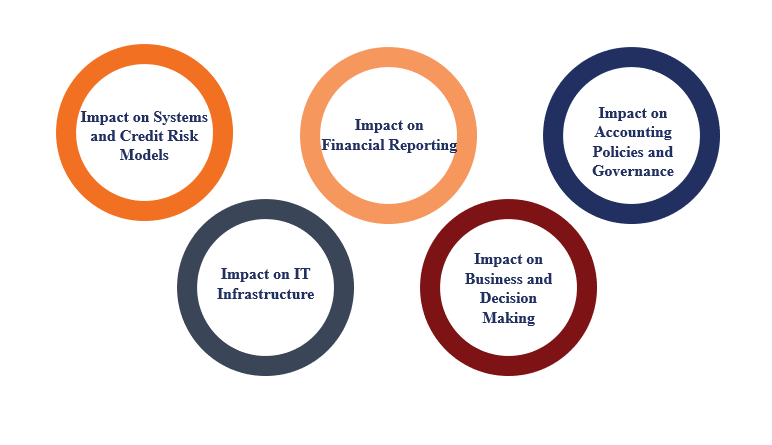
Of course, proper and in-depth analysis is needed to be able to identify what aspects the entity needs to pay attention to.
Next Steps and Solutions We Can Offer
- PSAK 413 Gap Difference Analysis
- Policy and Process Evaluation
Identify differences between your accounting policies, risk management, and business processes and the requirements of PSAK 413. - IT Readiness Assessment
Analysze IT system capabilities and data requirements to support the implementation of PSAK 413. - Adjustment Recommendations
Develop a step-by-step plan for comprehensive adaptation across all aspects of your operations.
- Policy and Process Evaluation
- Quantification of the Impact of PSAK 413
- Transition Impact Calculation
Estimating the impact of PSAK 413 on the opening balance of earnings upon first application. - Sustainable Impact Projections
Project the impact of PSAK 413 on your financial statements in future periods. - Methodology Development
Assist in designing standardized impairment calculation methodologies and assumptions.
- Transition Impact Calculation
- Implementation of PSAK 413 Calculation Tools
- Tool Selection and Configuration
Helps select and configure the right tools (both manual and automatic) for PSAK 413 calculations. - System and Data Integration
Ensuring your data and systems are seamlessly integrated to support the operation of these tools. - Training and Support for Users
Provide comprehensive training and support for your team to become proficient in using tools effectively.
- Tool Selection and Configuration
The precise implementation of accounting standards is a crucial step in strengthening an organization’s financial reporting structure and accountability. With a thorough understanding of each required parameter and methodology, entities can optimize asset management and ensure operational alignment with the dynamic regulatory framework. Consistent application of these standards serves not only as a form of compliance but also as a tool for maintaining long-term stakeholder trust. SW Indonesia can help do this to ensure that the expected quality and accuracy standards are achieved.